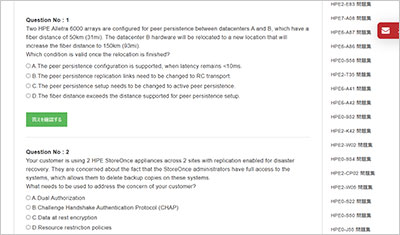
サンプル問題 1: Select the scenario where implementing FCoE would be an appropriate solution.
A: A large enterprise data center with existing Fibre Channel SANs is looking to reduce hardware complexity and costs by consolidating their storage and production networks onto a single infrastructure, while maintaining high performance for mission-critical applications.
B: A corporation needs to replicate data between data centers in different countries. The data must be synchronized in real-time across a WAN, and the solution must tolerate variable network conditions with minimal impact on performance.
C: A company with data centers in different states wants to establish a unified SAN infrastructure. The goal is to centralize storage management across all sites, using a single protocol that can efficiently handle high-latency, long-distance connections between data centers.
D: A tech startup is developing an AI-based application that relies heavily on machine learning models. The team needs a solution that allows them to access and process large datasets in the cloud.
正解:A
Explanation: Detailed Explanation: Rationale for Correct Answer Option A is correct because Fibre Channel over Ethernet (FCoE) is designed for large enterprise environments that already have Fibre Channel (FC) infrastructures but want to simplify cabling and reduce hardware by converging LAN and SAN traffic over a single Ethernet fabric. FCoE retains the efficiency, low latency, and reliability of Fibre Channel while leveraging Ethernet to minimize physical infrastructure costs. This aligns with HPE’s best practices for environments using HPE Alletra 9000/Primera or HPE Nimble arrays connected to converged networks where cost reduction and high performance are equally important. Analysis of Incorrect Options (Distractors): B: Real-time replication across WANs requires protocols like HPE 3PAR/Alletra Remote Copy, asynchronous/synchronous replication, or HPE Peer Persistence. FCoE is not suited for high-latency WANs because it is a LAN protocol designed for short distances within a data center. C: For inter-data center SAN unification, FCIP (Fibre Channel over IP) or iSCSI are more suitable. FCoE does not handle long-distance high-latency links effectively. D: A startup building AI applications with cloud workloads typically benefits from object storage (HPE Scality RING, HPE GreenLake for File and Object) or direct cloud-native APIs (S3/Blob). FCoE is irrelevant in this use case since it is on-prem and infrastructure-focused. Key Concept: The question is testing knowledge of FCoE and its appropriate deployment scenarios ― specifically, its role in consolidating storage and network traffic inside enterprise data centers while preserving Fibre Channel protocol advantages. Reference: HPE Storage Networking Best Practices Guide HPE Primera/Alletra 9000 Technical White Paper Fibre Channel over Ethernet Standards Overview (IEEE 802.1Qbb, 802.1Qaz)
サンプル問題 2: Your customer has deployed an HPE Alletra MP B10000 array in its virtualized environment. Data protection follows 3-2-1 best practices, with snapshots on the array, Veeam v12 backups, and storage on an external HPE StoreOnce appliance. Despite this, a ransomware attack made data recovery impossible. Your customer asks how to enhance data protection with immutability and application consistency. What is a possible solution using HPE Virtual Lock technology?
A: Enable Virtual Lock for each backup job inside Veeam v12
B: Enable Virtual Lock on the VMware datastores in VMware vCenter
C: Enable Virtual Lock on the HPE StoreOnce Catalyst stores
D: Enable Virtual Lock on the HPE Alletra storage array
正解:C
Explanation: Detailed Explanation: Rationale for Correct Answer Option C is correct because HPE StoreOnce Virtual Lock technology provides immutability at the Catalyst store level, preventing backup data from being deleted or modified for a defined retention period. This ensures ransomware or malicious actors cannot encrypt, alter, or delete the protected backups, aligning with modern data protection requirements for immutability and compliance. In integration with Veeam v12, backups stored on StoreOnce Catalyst stores can be locked, creating an additional immutability layer beyond application-consistent snapshots. Analysis of Incorrect Options (Distractors): A: Virtual Lock is not a Veeam feature. While Veeam v12 supports immutability on certain storage backends (object lock-enabled S3, hardened Linux repositories), HPE Virtual Lock is specific to StoreOnce Catalyst stores, not Veeam job settings. B: VMware vCenter datastores do not have a native immutability feature. Snapshots in vCenter can be deleted or corrupted during ransomware events, making this option incorrect. D: HPE Alletra arrays support application-consistent snapshots and replication, but they do not provide the immutability guarantee that StoreOnce Virtual Lock enforces. Array-level snapshots can still be deleted if admin credentials are compromised. Key Concept: This question targets knowledge of HPE StoreOnce Virtual Lock ― a feature designed to enforce immutability on Catalyst backup stores, making backup data resistant to deletion or alteration during ransomware or insider attacks. Reference: HPE StoreOnce Systems Technical White Paper HPE StoreOnce and Veeam Integration Best Practices HPE Data Protection Solutions for Ransomware Resilience Guide
サンプル問題 3: You are troubleshooting a storage environment using HPE Alletra Storage MP B10000 in a Peer Persistence configuration. A customer reports high latency when accessing data from applications. When reviewing the MPIO path status on the host, what should be the path status for connections to the storage array located in the remote data center?
A: Active Optimized
B: Passive
C: Active Non-optimized
D: Standby
正解:C
Explanation: Detailed Explanation: Rationale for Correct Answer In an HPE Peer Persistence configuration (supported on HPE Alletra MP, Primera, and 3PAR), hosts see volumes presented from arrays at both sites. For optimal load balancing and transparent failover, the local array paths are shown as “Active Optimized” while the remote array paths are marked “Active Non-optimized”. The “Non-optimized” label indicates these paths are functional but involve remote access with higher latency. This design ensures automatic transparent failover if the local site becomes unavailable. Distractors: A: “Active Optimized” applies only to local array paths, not remote ones. B: Passive paths are typical of ALUA implementations without Peer Persistence, not here. D: “Standby” is not the term used in Peer Persistence multipathing. Key Concept: MPIO with Peer Persistence (ALUA Active/Active configuration). Reference: HPE Primera/Alletra Peer Persistence Best Practices Guide.
HP HPE7-J02試験準備をしていますか?それとも自分は全部できそうです。復習する必要がないと思いますか?それとも自分は何もできないような気がします。どうすればいいでしょうか?実は、この問題を解決するのは難しくないです。勉強者がやるべきのは分解分析をマスターすることです。ここではHPE7-J02問題集を使って学習中の課題を確認し、知識を整理してAdvanced HPE Storage Integrator Solutions Written Exam試験の準備を進めます。
HPE7-J02問題集を利用して学習中の問題を探し出す。
HP HPE7-J02試験のすべての試験資料ポイントを勉強した後、HPE7-J02問題集の中の問題点を練習してみてください。重要な試験点はどこにあるか、つまりHPが把握してほしいものは何ですか?そして練習中の問題点を整理して分析してください。できない問題に対して、正しい答えの考えをはっきりさせたいです。それに関する知識点を明らかにします。間違った問題に対しては、具体的に自分がどこで間違っているかを見に行きます。このステップで使う試験資料ポイントは何ですか?間違った問題をこのように一歩分解して分析すると、自然に自分の復習する方向を見つけます。
その次に、非常規の試験ポイントのテーマは多すぎてこだわる必要はなくて、重要な試験点のテーマはきっと知識の点をわかります。特にAdvanced HPE Storage Integrator Solutions Written Exam試験は試験資料ポイントが多いです。一つの問題は知識ポイントだけではなく、復習する時はまとめをマスターして、記憶を分類します。知識ポイントが覚えていないか、間違えていないかのために点数をなくしてはいけません。