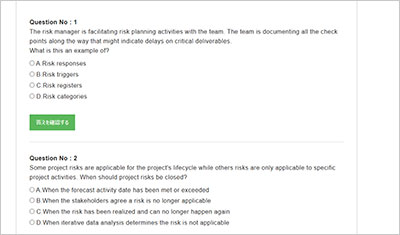
サンプル問題 1: As per the risk analysis process carried out for a project, two risks are registered. The probability risk A will occur is 40% and its monetary impact to the project is US$100,000. The probability risk B will occur is 60% and its monetary impact to the project is US$20,000. What is the total contingency budget that should be created?
A: US$68,000
B: US$52,000
C: US$120,000
D: US$80,000
正解:B
Explanation: In risk management, to calculate the contingency budget for risks, we use the Expected Monetary Value (EMV) formula: EMV=Probability of Risk×Impact of Risk\text{EMV} = \text{Probability of Risk} \times \text{Impact of Risk}EMV=Probability of Risk×Impact of Risk For Risk A: Probability: 40% or 0.40 Impact: US$100,000 \text{EMV of Risk A} = 0.40 \times 100,000 = US$40,000 For Risk B: Probability: 60% or 0.60 Impact: US$20,000 \text{EMV of Risk B} = 0.60 \times 20,000 = US$12,000 Total contingency budget = EMV of Risk A + EMV of Risk B 40,000 + 12,000 = US$52,000 Thus, the total contingency budget required for both risks is US$52,000. This approach follows PMI’s risk management guidelines, specifically under the "Quantitative Risk Analysis" process. This process focuses on determining numerical probabilities and monetary impacts to compute the expected financial impact of identified risks
サンプル問題 2: A risk manager notices that a risk owner is facing challenges implementing their response strategy and the costs are significantly exceeding expectations. What is the first thing the risk manager should do?
A: Highlight this situation to the project manager
B: Conduct a cost-benefit analysis
C: Change the risk response strategy
D: Analyze the situation and meet with the risk owner
正解:D
Explanation: The first thing the risk manager should do is analyze the situation and meet with the risk owner. This will allow the risk manager to understand the challenges faced by the risk owner and work with them to find a solution. Conducting a cost-benefit analysis or changing the risk response strategy may be necessary, but it is important to first understand the situation before taking any action. According to the PMI-RMP Exam Content Outline, one of the tasks in the domain of Risk Response Planning is to “assist the risk owners in developing and implementing risk response strategies and actions based on the agreed-upon risk response plan”. Therefore, the first thing the risk manager should do is to analyze the situation and meet with the risk owner to understand the root cause of the challenges and the cost overrun, and to discuss possible solutions or alternatives. Highlighting this situation to the project manager, conducting a cost-benefit analysis, or changing the risk response strategy are possible actions that can be taken after the analysis and meeting, but not before. Reference: PMI-RMP Exam Content Outline, Domain 3: Risk Response Planning, Task 31
サンプル問題 3: The risk manager also serves as a facilitator for a project and realizes the project team members have biases impacting how they perceive risks. What analysis is currently being used?
A: Quantitative risk analysis
B: Force field analysis
C: Qualitative risk analysis
D: Stakeholder analysis
正解:C
Explanation: The analysis currently being used is qualitative risk analysis. Qualitative risk analysis involves assessing risks based on their likelihood of occurrence and their potential impact on the project. This type of analysis can help identify biases that may be impacting how team members perceive risks. Qualitative risk analysis is the process of prioritizing individual project risks for further analysis or action by assessing their probability of occurrence and impact as well as other characteristics. Qualitative risk analysis helps to identify the most significant risks that require attention and response planning. One of the tools and techniques used in qualitative risk analysis is risk data quality assessment, which evaluates the degree to which the data about individual project risks is useful for risk management. Risk data quality assessment considers various aspects of data quality, such as reliability, accuracy, integrity, precision, and bias. Bias is the tendency of human judgment to be influenced by personal or organizational preferences, assumptions, beliefs, or emotions, rather than by objective facts or evidence. Bias can affect how project team members perceive and assess risks, leading to inaccurate or incomplete risk analysis results. Therefore, the risk manager who realizes the project team members have biases impacting how they perceive risks is currently using qualitative risk analysis to prioritize the risks and assess the quality of risk data. Reference: PMI, Practice Standard for Project Risk Management, 2009, p. 37-38, 41-42.