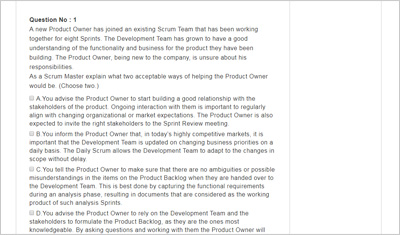
サンプル問題 1: Paul is a Product Owner for multiple products. Each product is allocated a dedicated Scrum Team and a set budget. Based on the average velocity of a previous product release, Paul had estimated a new product to take 9 Sprints to complete. The average velocity of the previous product release was 50 completed units of work per Sprint. Over the first 3 Sprints, the Development Team reported an average velocity of 40 completed units per Sprint, while not fully completing the required integration tests. The Development Team estimates that integration testing would require additional effort to make the increments shippable. The Development Team is unsure if the required velocity is achievable. What is the most effective way to recover?
A: In the next Sprints, the Development Team strives to make the selected work as close to ‘done’ as possible and at the minimum 90% completed. Any undone work is divided into new Product Backlog Items that will be deferred to the last Sprint in order to maintain stable velocity.
B: The Development Team informs Paul that the progress he has perceived to date is not correct. The Increment is not releasable. They give Paul their estimate of the effort it would take to get the previous work ‘done’, and suggest doing that work first before proceeding with new features. The team also reestimates the effort to make the remaining Product Backlog items ‘done’, including all integration effort. In the end, it is Paul’s call to continue the project or to cancel.
C: The Scrum Master will manage the Sprint Backlog and assign work to the Development Team members to ensure maximum utilization of each member. He/she will keep track of unused resources so that it does not impact the budget. Unused budget can be allocated for additional Sprints if needed.
D: The Scrum Master sets the open work aside to be performed in one or more release Sprints. They remind Paul to find funding for enough Release Sprints in which this remaining work can be done. Up to one release Sprint per three development Sprints may be required. It is Paul’s role to inform users and stakeholders of the impact on the release date.
正解:B
Explanation: Scrum is founded on empirical process control and asserts that knowledge comes from experience and making decisions based on what is known. Scrum employs an iterative, incremental approach to optimize predictability and control risk. At the end of every Sprint, an increment of ‘done’ work must be available in order to inspect and adapt accordingly.
サンプル問題 2: Paul, a Product Owner of one of the Scrum Teams, has been attending the Daily Scrum. During the Daily Scrum, the Development Team members have been reporting their daily work to Paul so that he is aware of their Sprint progress and what each member is working on. What is the best action for the Scrum Master to take?
A: Ask Paul to stop attending the Daily Scrum.
B: Coach Paul and Development Team members on the purpose of the Scrum events and let them figure out what to do in this situation.
C: Allow the Paul to participate in the Daily Scrum as he is responsible for the success of the product.
D: Facilitate the Daily Scrums to avoid any conflicts between the Development Team members and Paul.
正解:B
Explanation: Because the Development Team is the ones doing the work, they are best suited to inspect and adapt the progress toward the Sprint Goal. At minimum, this is done every 24 hours through the Daily Scrum. It is the Scrum Master’s responsibility to teach the Scrum Team the value and objective of each Scrum event in order for them to optimize the benefits of each event. Because the Daily Scrum is owned by the Development Team, it is up to them on how they should run it but the Scrum Master can provide guidance to ensure it adheres to the Scrum guidelines.
サンプル問題 3: At the end of the eighth Sprint, the internal sponsors are upset and angry with the progress of the product being built. The current state of the product is not as expected and will require additional Sprints and more budget than originally anticipated at the start of the project. What factors may have led to this? (Choose three.)
A: The Product Owner has not been engaging with sponsors frequently enough and has not been kept aware of the overall progress of the project.
B: The sponsors haven’t been using the Sprint Reviews to actively engage, and inspect and evaluate progress.
C: The scope changes have not been tracked adequately and the change request process has not been followed properly.
D: The stakeholders have not been using the Daily Scrum effectively to track the Development Team’s progress.
E: The Scrum Master has not ensured transparency.
F: The project plan proposed to the sponsors at the start of the project followed stringently.
正解:A, B, E
Explanation: One of the principles of agility includes working closely with business people. In order to manage stakeholder expectation, there must be open communication (through collaboration and transparency) throughout the project cycle. This maximizes alignment, helps with making business decisions, and reduces risk. Although, the Scrum Guide does not directly state that the Scrum Master is responsible for ensuring transparency it is implicit. The Scrum Master is responsible for the process in which Scrum is adopted and enacted. Scrum is founded on empiricism and the Scrum Master helps those inside and outside the team work in an empirical environment which includes transparency (one of the three pillars of empiricism).
Scrumの専門知識やスキルを十分に理解していても、事前の問題演習が不足しているためにScrum PSM II試験で実力を十分に発揮できないケースが少なくありません。このPSM II 問題集を活用することで、問題形式に慣れながら計画的に復習を進めることができます。
PSM II 問題集の役割は何ですか?
PSM II 問題集の役割は、Scrum PSM II試験に向けた復習を行い、学習中の理解度を客観的に評価するためのツールとして使用できることです。