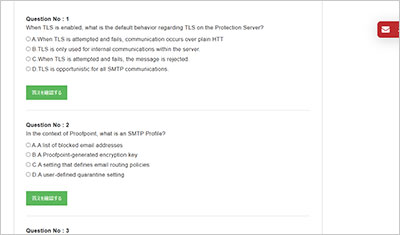
サンプル問題 1: In the context of spam detection, what is the primary function of Proofpoint Dynamic Reputation (PDR)?
A: To provide training for users on how to identify spam.
B: To filter emails based on user-defined rules.
C: To assess the sending MTA’s reputation based on its IP address.
D: To analyze email content for spam keywords.
正解:C
Explanation: Proofpoint Dynamic Reputation (PDR) is designed to evaluate the reputation of the sending host at the connection level, using the sender’s IP address as the core signal. In Proofpoint’s own public description of PDR, the technology uses many features to determine the reputation of a particular IP and delays or blocks mail when that IP shows indications of spam activity. That means PDR is not primarily a user training feature, not a user-defined inbox rule engine, and not a simple keyword scanner of message body text. Its job is to assess the sending MTA before full message acceptance and use that reputation to influence how the system handles the connection. This is exactly why PDR is valuable in early-stage filtering: it helps reduce unwanted traffic before deeper content analysis takes place. Proofpoint’s spam architecture also describes a multilayered defense where connection-level analysis includes Dynamic Reputation alongside SPF, recipient verification, and other connection checks. In practical administrator terms, PDR is part of the front-line evaluation of the source system’s trustworthiness, helping the platform identify suspicious or compromised senders quickly and efficiently. That makes the correct answer the option focused on assessing the sending MTA’s reputation by IP address
サンプル問題 2: If an email is incorrectly filtered as spam, what should an administrator do first when reviewing the filter logs?
A: Reclassify the email manually.
B: Look for the rule that triggered the action.
C: Restart the Proofpoint server.
D: Delete the email from the quarantine.
正解:B
Explanation: When an administrator investigates a false positive in Proofpoint, the first objective is to determine exactly what rule or final action caused the message to be handled as spam. Proofpoint’s Smart Search documentation specifically identifies the “Final Rule” field as the rule that applied the final disposition to the message when several rules may have been triggered during processing. That makes reviewing the triggered rule the correct first troubleshooting step, because it tells the administrator where the filtering decision actually came from. Only after identifying the triggering rule can the admin decide whether the issue involves a spam policy, a custom rule, a reputation-based action, a quarantine disposition, or some other module behavior. Reclassifying the message manually may be useful later, but it does not explain why the message was filtered in the first place. Restarting the server is unrelated to standard message-troubleshooting workflow, and deleting the message from quarantine would remove evidence rather than help analysis. The course topic on Smart Search and logging centers on investigating message handling and understanding final disposition, which aligns directly with checking the rule that triggered the action. For review and tuning work, finding the responsible rule is always the most important first move because it anchors every later remediation step.
サンプル問題 3: Which Email Firewall features should be used together to mitigate directory harvest attacks?
A: Outbound Throttle
B: SMTP Rate Control
C: Dictionaries
D: Bounce Management
E: Recipient Verification
正解:A, B, E
Explanation: Directory harvest attacks try to discover valid recipient addresses by sending large numbers of SMTP recipient attempts and observing which addresses are accepted or rejected. In Proofpoint’s layered connection-level defenses, Recipient Verification and SMTP Rate Control are the two features that work together most directly against this problem. Recipient Verification checks whether the addressed mailbox is valid, while SMTP Rate Control helps detect and automatically block or throttle abusive SMTP connection behavior. Proofpoint’s published spam detection material describes connection-level analysis that includes recipient verification and Dynamic Reputation, and then states that based on this analysis, SMTP rate control is used to automatically block or throttle malicious connections, providing strong protection against directory harvest and denial-of-service attacks. That pairing is exactly what makes these two options the correct answer. Outbound Throttle is aimed at controlling excessive outbound mail from accounts, not inbound recipient enumeration. Dictionaries are content and pattern controls, not recipient-existence validation controls. Bounce Management deals with BATV-style handling of backscatter, which is a different problem space. The Threat Protection Administrator course topic list also places SMTP Rate Control and Recipient Verification together under the same operational area, reinforcing that they are complementary controls for this class of attack. For a directory harvest scenario, these are the right two protections to deploy together.